
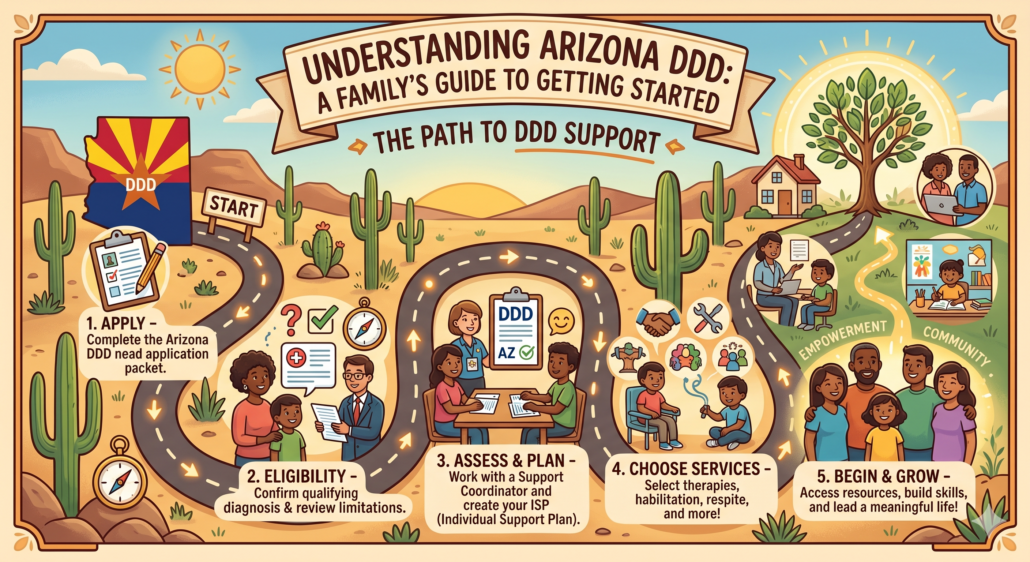
Understanding Arizona DDD: A Family’s Guide to Getting Started
If your child or loved one has a developmental disability, you’ve probably heard about “DDD”—but figuring out what it is, who qualifies, and how to actually get services can feel overwhelming. You’re not alone, and the process is more navigable than it first appears.
This guide breaks down Arizona’s Division of Developmental Disabilities in plain language: what it is, who’s eligible, how to apply, the services available, and how to choose a provider you can trust. Whether you’re just beginning or trying to make sense of next steps, here’s what every Arizona family should know.
What Is the Arizona Division of Developmental Disabilities (DDD)?
The Division of Developmental Disabilities (DDD) is part of the Arizona Department of Economic Security (DES). Its purpose is to support individuals with developmental disabilities—and their families—so they can live as independently as possible and take part fully in their communities.
DDD connects eligible individuals with a wide range of long-term supports, from in-home care to skill-building programs to employment assistance. Many of these services are funded through Arizona’s Medicaid system (AHCCCS) by way of the Arizona Long Term Care System (ALTCS), which means qualifying families can access them at little to no cost.
In short: DDD is the front door to developmental disability services in Arizona.
Who Qualifies for DDD in Arizona?
Eligibility for DDD is based on a qualifying developmental disability that began before adulthood and is expected to continue indefinitely. Arizona recognizes the following qualifying conditions:
- Intellectual disability (cognitive disability)
- Autism
- Cerebral palsy
- Epilepsy
In general, the condition must have originated before age 18, be likely to continue, and result in substantial limitations in major areas of daily functioning.
There is also a separate category for young children (birth to age 6) who are “at risk” of a developmental disability, so families can access early support before a formal diagnosis is established.
Important: Eligibility criteria and definitions can be updated over time. Always confirm current requirements directly with DDD before making decisions about your family’s care.
How to Apply for DDD Services in Arizona
While every family’s situation is unique, the path to services generally follows these steps:
1. Submit an application
You’ll start by completing a DDD eligibility application through DES. You’ll typically need documentation of the diagnosis, along with medical, psychological, or developmental records that support it.
2. Complete the eligibility determination
DDD reviews your application and supporting records to determine whether your loved one meets the criteria for a qualifying developmental disability.
3. Apply for ALTCS (if seeking long-term services)
Many DDD services are funded through the Arizona Long Term Care System (ALTCS). ALTCS has its own financial and medical eligibility requirements, so this is often a separate but parallel step.
4. Get assigned a Support Coordinator
Once eligible, your family is assigned a DDD Support Coordinator. Think of this person as your guide and main point of contact—they help you understand your options, coordinate services, and advocate alongside you.
5. Build your Individual Support Plan (ISP)
You and your Support Coordinator create a Person-Centered Plan, documented in an Individual Support Plan (ISP). This plan identifies your loved one’s goals, needs, and the specific services that will help them thrive. (For early intervention with very young children, this may take the form of an Individualized Family Service Plan instead.)
6. Choose your providers and begin services
With an approved plan in place, you select Qualified Vendors to deliver the authorized services—and care can begin.
What Services Does DDD Offer?
DDD supports a broad spectrum of needs across the lifespan. Depending on eligibility and the Individual Support Plan, available services often include:
- In-home services — support delivered right where your loved one is most comfortable
- Habilitation — skill-building to develop daily living, self-care, communication, and community abilities
- Respite care — temporary relief that gives family caregivers a chance to rest and recharge
- Attendant care — hands-on assistance with daily living activities
- Homemaker services — help with essential household tasks
- Day programs (day treatment and training) — structured, community-based programming
- Employment and pre-vocational supports — help building job skills and finding meaningful work
- Residential services — supported living arrangements for those who need them
- Therapies, nursing, and transportation — additional supports as identified in the plan
Not every family needs every service—the right mix is built around your loved one’s individual goals.
What Is a DDD Qualified Vendor (and Why It Matters)?
A DDD Qualified Vendor is a provider that has been approved and contracted to deliver DDD-funded services in Arizona. Working with a Qualified Vendor matters because it means the provider has met the state’s standards for delivering care.
Qualified Vendors and their staff are generally held to requirements such as:
- Fingerprint Clearance Cards and background checks
- CPR and First Aid certification
- Training in areas like Article 9 (for supporting behavioral needs)
- Health screenings and ongoing education
When you choose a Qualified Vendor, you’re choosing a provider accountable to these standards—an important layer of safety and peace of mind.
How to Choose the Right DDD Provider
Once you’re ready to select services, the provider you choose makes a real difference in your family’s day-to-day experience. As you compare options, consider:
- Are they a DDD Qualified Vendor? Confirm they’re contracted to provide the specific services you need.
- What’s their staff training and screening like? Ask about certifications, background checks, and ongoing education.
- How consistent is their care? Frequent caregiver turnover is stressful—ask about staff retention and continuity.
- Do they offer the services you need now and later? A provider that offers in-home care, respite, habilitation, and more can grow with your family.
- Do they communicate well? You want a provider that keeps you informed and treats your family as a partner.
- Is bilingual support available? For many Arizona families, Spanish-speaking caregivers are an important consideration.
- What do other families say? Reviews and referrals offer valuable insight into what working with them is really like.
Frequently Asked Questions About Arizona DDD
Does DDD cost money? Many DDD services are funded through Arizona’s Medicaid program (AHCCCS) via ALTCS, meaning eligible families often receive services at little to no out-of-pocket cost. Financial eligibility for ALTCS is determined separately.
How long does it take to get DDD services? Timelines vary based on documentation, eligibility determination, and planning. Staying organized with your records and working closely with your Support Coordinator can help keep the process moving.
What’s the difference between DDD and AHCCCS? AHCCCS is Arizona’s Medicaid program. DDD is the division that serves individuals with developmental disabilities, and it often uses AHCCCS/ALTCS funding to pay for long-term services. They work together.
Can I switch providers if I’m not satisfied? Yes. Families generally have the right to choose—and change—their Qualified Vendors. Your Support Coordinator can help you make a change if your current provider isn’t the right fit.
My child is very young—can they still get help? Possibly. Arizona has supports for young children who are at risk of a developmental disability, so it’s worth reaching out early rather than waiting.
Getting Started Is Easier With the Right Partner
Navigating DDD for the first time can feel like a lot—but you don’t have to do it alone. The right provider doesn’t just deliver services; they help you understand your options, coordinate with your Support Coordinator, and make sure your loved one gets care that honors their dignity and independence.
At LFC, we’re proud to support Arizona families with compassionate, person-centered in-home and residential services. If you have questions about getting started with DDD—or you’re ready to explore care for your loved one—we’re here to help. Contact us today to learn more.









Leave a Reply
Want to join the discussion?Feel free to contribute!