

Can I Get Paid to Take Care of My Child with a Disability in Arizona?
It’s one of the most common questions Arizona parents ask — and one of the most misunderstood: Can I actually be paid for the care I already give my child? For many families, the answer is yes. Arizona allows parents and family members to be paid caregivers through DDD, and it can be a genuine relief for households where caregiving makes outside employment difficult. Here’s how it works, in plain language.
Important: The rules for paying parents of minor children have been changing recently, including how care hours are assessed. This article explains the framework, but always confirm the current details with your DDD Support Coordinator, because specifics can shift.
The Short Answer
- Parents of minor children can be paid to provide certain care through a program called Parents as Paid Caregivers (PPCG) — with specific rules and an hourly cap.
- Family members of adult children can also be paid to provide care, generally without the same hourly cap.
- Relatives, friends, and other trusted people can frequently be hired and trained as paid caregivers through a provider agency, even when they aren’t parents.
In other words, the person caring for your loved one often can be someone you already know and trust — including you.
How the PPCG Program Works (Parents of Minors)
The Parents as Paid Caregivers (PPCG) service model lets a parent be paid to provide direct-care services — such as Attendant Care and hourly Habilitation — to their own minor child. It began during the COVID-19 public health emergency and was later made a permanent option under Arizona’s federal Medicaid waiver.
A few key rules define the program:
It pays for “extraordinary care,” not ordinary parenting
PPCG compensates parents for extraordinary care — disability-specific support that goes beyond what a parent would ordinarily do for a child of the same age without a disability, and that’s needed to keep the child healthy and safe at home. Routine parenting tasks — general housekeeping, laundry, meal prep, and ordinary supervision — are not billable.
There’s a weekly hour cap
As of July 1, 2025, a parent caregiver under PPCG may bill up to 40 hours per week per child. If your child is authorized for more than 40 hours, a qualified non-parent caregiver must provide the additional hours. Where two parents care for the same child, their combined paid hours can’t exceed the per-child cap; where a parent cares for two children, the limits apply per child.
You work through one agency
To be paid, the parent becomes a Direct Care Worker (DCW) employed or contracted by a single DDD-registered provider agency (a Qualified Vendor). The agency handles training, payroll, and compliance.
There are eligibility requirements
The child must be enrolled in ALTCS and authorized for Attendant Care and/or Habilitation through DDD. The parent must have formal physical and/or legal custody of the minor (biological, adoptive, or legal guardian — stepparents don’t qualify unless they legally adopt). Parents also must be at least 18, complete required training, and pass background checks. A fingerprint clearance card is generally required, though there’s an exception for a parent providing only Attendant Care who lives in the same home as the child.
Some tasks and times aren’t billable
There are guardrails on when and what a parent can bill — for example, care generally can’t be billed while the child is at school, during certain inpatient stays, or when the child isn’t present. Your agency and Support Coordinator will walk you through the current rules.
A Note on the “Extraordinary Care” Gap
Here’s something families should understand: your child’s authorized hours and what a parent is allowed to bill aren’t always the same. A child may be authorized for more care than a parent can personally claim under PPCG. This doesn’t reduce your child’s services — it changes who can provide some of those hours. Many families use a mix of parent-provided care (up to the cap) and a trusted non-parent caregiver for the rest. If you believe your child needs more hours than an assessment shows, ask your Support Coordinator about the Extraordinary Care Review process.
What About Adult Children and Other Family?
If your loved one is an adult, parents and family members can generally be paid to provide care without the 40-hour weekly cap that applies to parents of minors. And across ages, relatives and other trusted people can often be hired and trained as caregivers through an agency. There’s also a Licensed Health Aide pathway that allows certain family members to provide nursing-related services when the member is approved for private-duty nursing or skilled nursing respite — this requires specific nursing-board-approved training and working through an approved home health agency.
A Word on Taxes and Other Benefits
Two things worth knowing:
- Payments a parent receives for providing this care may qualify as “difficulty of care” payments, which can be excluded from income for federal tax purposes in some situations. A tax professional can advise on your specific circumstances.
- The extra income could affect eligibility for other assistance programs (like SNAP) for your household. It’s worth thinking through the full picture before you begin.
How to Get Started
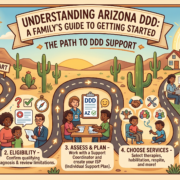
- Confirm your child’s DDD eligibility and ALTCS enrollment. (See our DDD application guide and ALTCS guide.)
- Make sure Attendant Care and/or Habilitation is authorized in your child’s service plan.
- Talk with your Support Coordinator about choosing the PPCG service model at your planning or review meeting.
- Partner with a DDD-registered agency that can employ or contract with you as a Direct Care Worker and handle training and payroll.
Frequently Asked Questions
Can I really get paid to take care of my own child? In many cases, yes. Through the PPCG program, parents of eligible minor children can be paid to provide certain care, and family members of adult children can be paid as well.
How many hours can I be paid for? For parents of minors under PPCG, up to 40 hours per week per child (as of July 1, 2025). Additional authorized hours must be provided by a non-parent caregiver. Adult-child care generally isn’t subject to this cap.
Do I need any training or certification? Yes. You’ll become a Direct Care Worker through an agency, which means completing required training and passing background checks.
Will this affect my taxes or other benefits? It might. Payments may qualify as excludable “difficulty of care” income, but the extra earnings could affect other benefits. Consult a tax professional and consider the full household picture.
Why do the rules seem to keep changing? Arizona has been actively revising how care hours for minor children are assessed. Because of this, confirm the current rules and your child’s specific authorization with your Support Coordinator.
Interested in being paid to care for your loved one? We are a DDD-registered agency that helps Arizona parents and family members become paid caregivers — we handle the training and paperwork so you can focus on your family. Contact us to see if you qualify.
This article is for general information and isn’t legal, tax, or medical advice. The PPCG program and related rules change; confirm current details with your DDD Support Coordinator, at des.az.gov, or at azahcccs.gov.









Leave a Reply
Want to join the discussion?Feel free to contribute!